- Home
- About Us
- Mortgage Solutions
- Second Mortgages
- Home Equity Loans
- Refinance Mortgages
- Debt Consolidation Mortgages
- Bad Credit Mortgages
- Self Employed Mortgages
- Personal Loans
- Home Improvement Mortgages
- First Time Home Buyer Mortgages
- New To Canada Mortgages
- Spousal Buyout Mortgages
- Bridge Loans
- Mortgage Renewals
- Consumer Proposal Payout
- Stop Power Of Sale
- Commercial Mortgages
- Business Loans
- Resources
- Calculator
- Market Trends
- Reviews
- Collaboration
- Contact


- Home
- About Us
- Mortgage Solutions
- Second Mortgages
- Home Equity Loans
- Refinance Mortgages
- Debt Consolidation Mortgages
- Bad Credit Mortgages
- Self Employed Mortgages
- Personal Loans
- Home Improvement Mortgages
- First Time Home Buyer Mortgages
- New To Canada Mortgages
- Spousal Buyout Mortgages
- Bridge Loans
- Mortgage Renewals
- Consumer Proposal Payout
- Stop Power Of Sale
- Commercial Mortgages
- Business Loans
- Resources
- Calculator
- Market Trends
- Reviews
- Collaboration
- Contact
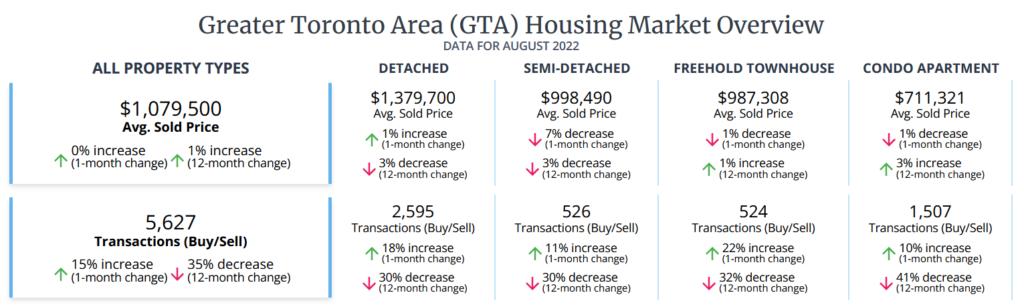
Renewed market activity in Toronto’s housing market during the month of August 2022 helped to cushion Toronto home prices and brought about the first month-over-month price increase since February 2022. The average home sold price in the Greater Toronto Area (GTA) increased to $1,079,500 in August 2022, a 0.4% increase compared to last month. That stops the slide in home prices that the GTA has been seeing since the peak in home prices in February. Compared to last year, GTA home prices are up 1% year-over-year.
Even so, home prices are still down by 19% compared to February 2022. That’s a significant drop which is largely due to higher interest rates and increased borrowing costs. It also takes close to $255,000 off the average home sold price in the GTA in the past six months.
A surprising month-over-month increase in prices was also met with a month-over-month increase in sales activity. GTA home sales are up by 15% compared to last month, with 5,627 home sales for the month of August 2022. Even though home sales are still down by over 34% year-over-year, this bump up in sales activity is the first month-over-month sales increase since March 2022.
Higher August sales has been coupled with a slight decrease in new listings. New listings are down to 10,537, a 13% month-over-month decrease and a 1% decrease year-over-year. This brings Toronto’s sales-to-new-listings ratio (SNLR) to 53%, higher than last month’s SNLR of 41% but lower than last year’s SNLR of 81%.
The Toronto Regional Real Estate Board (TRREB) suggested in its August 2022 market report that a higher sales-to-new-listings ratio may help prop up Toronto home prices as the housing market enters the busy fall season. It remains to be seen whether this month has been an outlier or whether sales activity will continue to increase. Meanwhile, Toronto’s 12-month SNLR moving average has decreased to 57.6%. Having an SNLR above 70% signals a seller’s market. This month’s SNLR shows that Toronto’s real estate market is still moving towards a more balanced market.
The MLS Home Price Index (HPI) Benchmark Price for the GTA was $1,124,600 for August 2022, down 3% month-over-month from $1,157,500 in July 2022. This is the fifth month in a row that the GTA’s benchmark home price has decreased month-over-month. Prior to April 2022, the benchmark price had risen for 19 consecutive months starting from August 2020 until the peak in the GTA’s benchmark home price in March 2022. Even though the GTA’s average sold price increased this month, the benchmark home price has extended its monthly decrease.
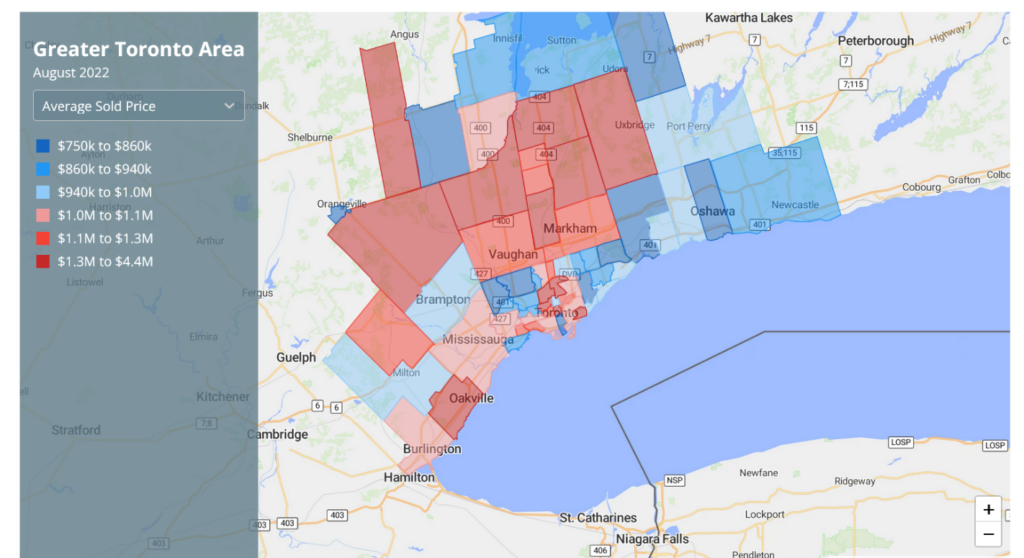
The average home sold price for the City of Toronto was $1,031,979 for August 2022, a 1% increase to last month’s average home sold price of $1,019,100. It also translates to a 3% increase year-over-year.
Other areas of the GTA have seen mixed growth. Mississauga’s average home price for August 2022 was $1,077,092, up 12% year-over-year and up 1% month-over-month. Brampton’s average home price was $1,018,639 for August 2022, down 4% year-over-year and down 1% month-over-month.
Oakville home prices have increased by 7% year-over-year to $1,587,619, up 4% from last month, while Markham home prices decreased 1% year-over-year to $1,273,428, up 3% from last month. Vaughan home prices are down 3% year-over-year to $1,274,395. Some areas of the GTA housing market have started to see an annual decline in average sold prices, while other areas continue to see year-over-year price growth.
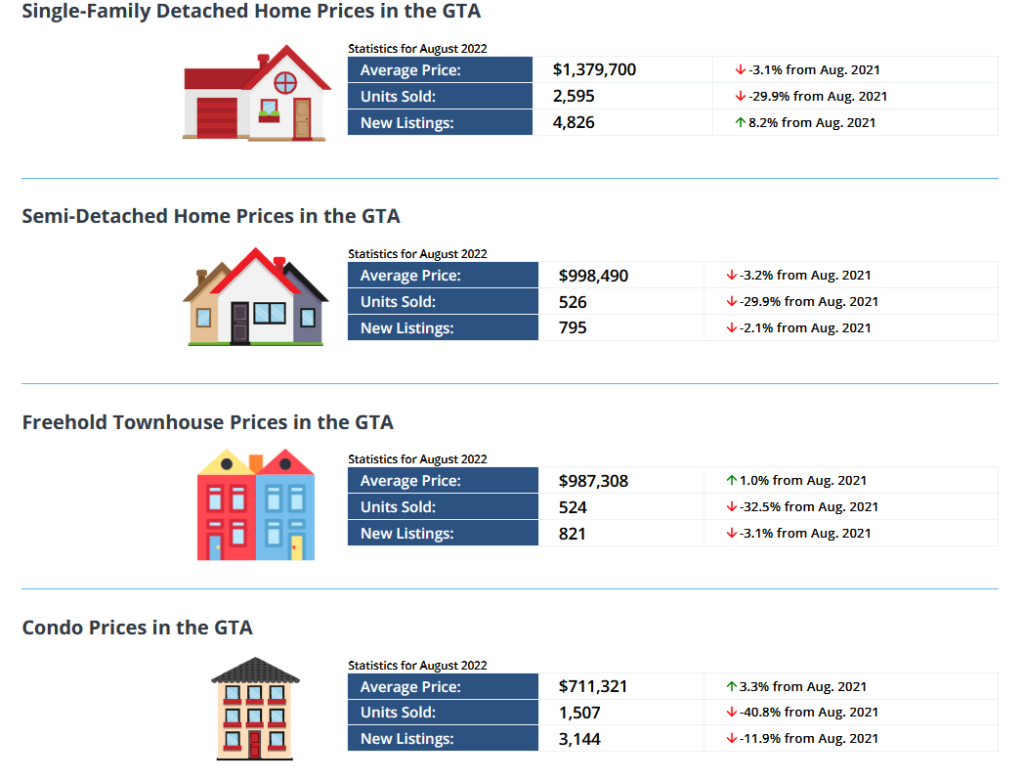
Breaking down the GTA’s average home prices into property types for the month of August 2022, the average price of detached homes was $1,379,700, down by 3% compared to last year. However, it’s still a monthly increase of 1% compared to July 2022’s average detached home price of $1,362,598. The average sold price of a detached home peaked at $1,797,203 back in February 2022. This means that detached home prices in the GTA have since fallen by 23% in the past six months, a decline of over $417,000.
The average price of semi-detached homes in the GTA was $998,490, a shocking 7% decrease from last month and down 3% year-over-year. This is the first time that the GTA’s average price of semi-detached homes has been under $1 million since January 2021.
The average price of freehold townhouses was $987,308, up 1% year-over-year. Condo townhouses had an average price of $789,386 and a 3% annual gain. For condos, the average price was $711,321 , up 3% year-over-year.
Prices for detached and semi-detached homes have seen year-over-year decreases, while prices for less expensive property types, such as townhouses and condos, have held onto their annual price gains.
The average sold price for August 2022 was 98% of the average listing price, down from the 99% ratio seen in July 2022 and from the 105% ratio seen last year in August 2021. This means that the average home in Toronto was sold for less than its listing price this month, with the average not being sold over asking.
Average listing days on market were 22 days in August 2022, increasing from 16 days in August 2021.
The expansion of the CMHC First-Time Home Buyer Incentive in 2021 likely provided a short-term boost to condos in the Toronto region. First-time home buyers in the Toronto CMA spanning from Oakville to Oshawa, as well as the Vancouver and Victoria CMAs, are eligible to borrow 5% or 10% of a property’s price from the Federal government for their down payment interest-free. The expansion increased the maximum household income limit from $120,000 to $150,000 and the total borrowed amount from 4x household income to 4.5x household income, which increased the home price limit from approximately $500K to more than $700K. However, usage of this program has been low amongst first-time homebuyers in Canada.
In addition, the CMHC decreased their standards for insured mortgages in 2021. This reverses the increase in standards set in 2020 and drops required credit scores from 680 to 600. This change also increases GDS and TDS ratio limits to 39% and 44% from 35% and 42%, respectively.
However, the Office of the Superintendent of Financial Institutions (OSFI) and the Department of Finance Canada also raised the benchmark mortgage stress test rate in 2021 for both insured and uninsured borrowers from 4.79% to 5.25%, limiting affordability for marginal buyers.
Mortgage rates have risen from their 2020 lows and are expected to rise further this year. The first rate hike by the Bank of Canada occurred on March 2, 2022, followed up by a series of aggressive hikes that may continue well into late this year. This will cause Toronto mortgage rates to rise and lead to a drop-off in housing demand.